

Picture quality
Best quality, Balanced and Fastest trade encoder effort for headroom. Best quality spends the most CPU per frame and looks sharpest; Fastest spends the least and is the one to reach for if your machine cannot keep up at your chosen resolution. If pictures start dropping or the fan spins up under load, step down one level before touching anything else on this tab.Pick a network preset
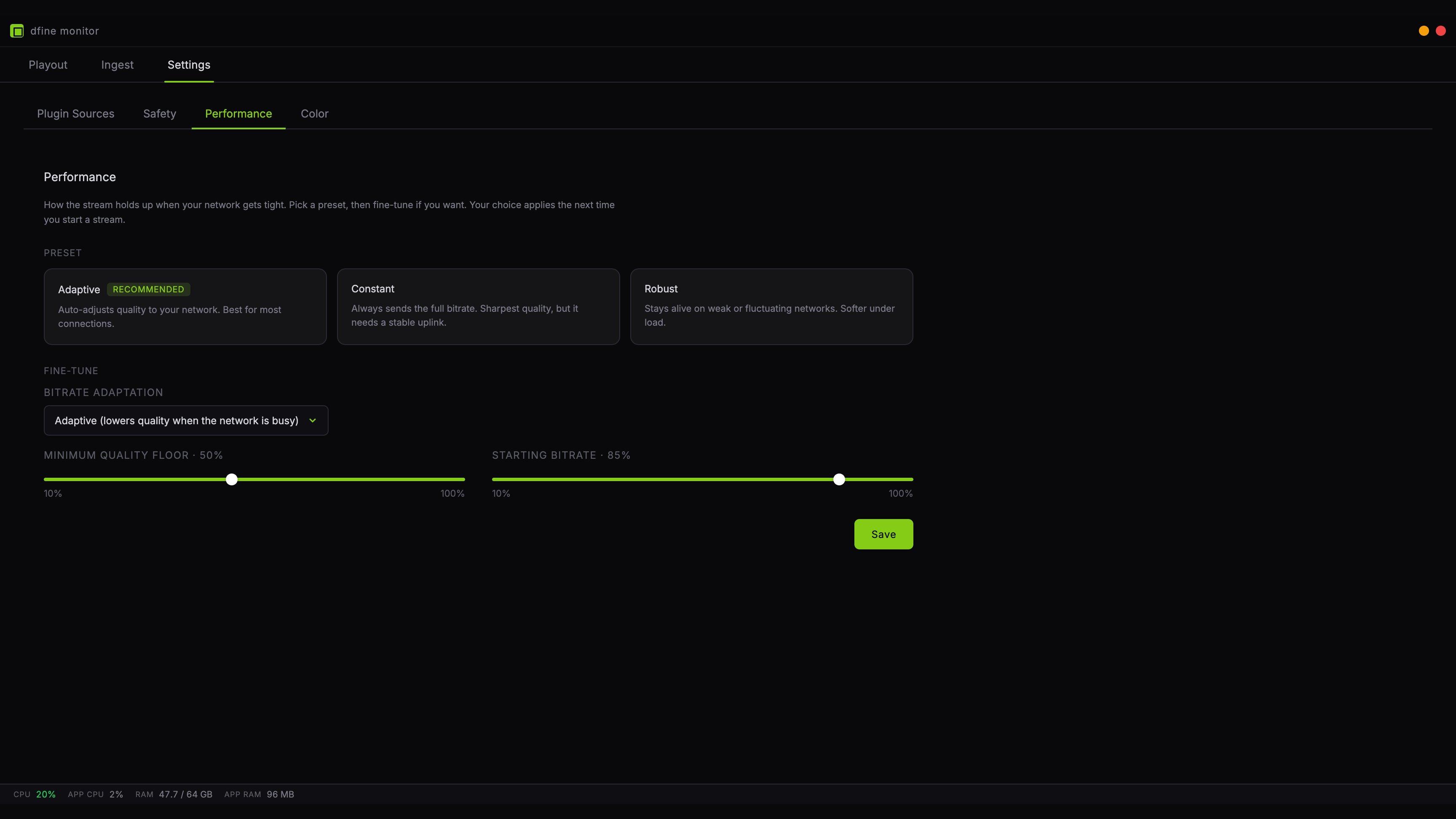
Three presets cover the usual situations. Each one loads its values into the fields below, where you can still adjust them. Adaptive watches the connection and lowers quality when the line gets busy, then comes back up. This is right for almost everyone and it is the default. Constant always sends the full bitrate and never adapts. The sharpest picture you can get, but on a weak line it stutters instead of softening. Use it when you know the connection holds, for example on a wired office line. Robust gives up quality earlier and more willingly. On a hotel connection or a mobile hotspot this keeps the picture moving where Adaptive would still be fighting.Fine-tune
Below the presets are the individual values. Change one and the preset selection simply releases, because your configuration is now your own. Minimum quality floor is how far the automatic control may go down, as a percentage of your bitrate. Without a floor, a brief burst of motion can push the quality down much further than necessary, and the picture takes a while to recover. Adaptive sets it to twenty percent. Starting bitrate is what the encoder begins with, before the automatic control has measured anything. At one hundred percent the picture is sharp from the first frame, but on a weak line the first seconds may stutter until the control pulls back. A lower value starts safely and sharpens within a few seconds.With Constant both values have no effect, so they are dimmed. Without automatic control there is nothing to limit.